
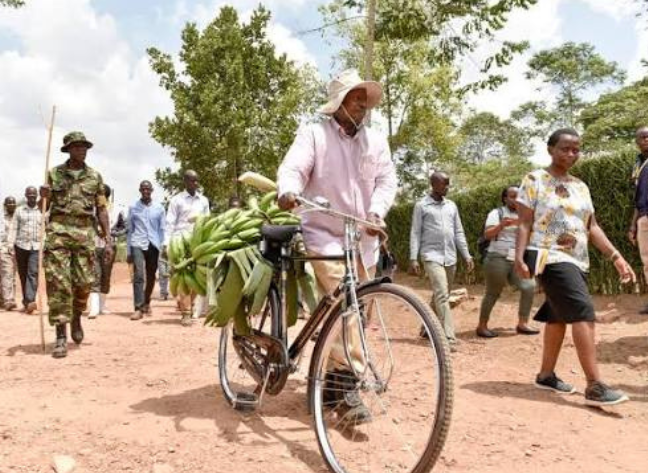

Kampala, Uganda | President Yoweri Museveni has recalled how he rode bicycles and walked long distances to mobilise communities during the early years of Uganda’s liberation struggle, saying leaders do not need allowances to help citizens overcome poverty.
Delivering the State of the Nation Address at Kololo Ceremonial Grounds on Thursday, Museveni said that in the 1960s and 1970s, he and fellow activists travelled across rural areas by bicycle and on foot to educate people on wealth creation and economic transformation.
He argued that leadership should be driven by commitment and ideas rather than the distribution of money, criticising leaders who claim they need facilitation to reach their constituents.
The President said Uganda’s economic transformation began with efforts to persuade communities, especially in the cattle corridor, to abandon nomadic lifestyles and embrace commercial agriculture, particularly dairy farming.
According to Museveni, milk production has increased from 200 million litres in 1986 to 5.4 billion litres annually, turning Uganda into a major exporter of dairy products while reducing dependence on imports.
He cited the dairy sector as evidence that Ugandans can escape poverty through commercial agriculture, proper planning, and government support programmes.
Museveni reiterated his “No More Sleep” message, explaining that it is a call to end corruption, laziness, poor leadership, and actions that divert citizens from productive activities.
He said leaders who fail to deliver services should not continue holding office, stressing that leadership is meant to serve citizens and drive development.
The President highlighted government interventions aimed at fighting poverty, including the Parish Development Model (PDM), Emyooga, Operation Wealth Creation, and the National Agricultural Advisory Services programme.
He revealed that PDM has so far reached 3.7 million households and that the government will continue injecting funds into parishes and urban wards to support wealth creation initiatives.
On the economy, Museveni said Uganda’s Gross Domestic Product has grown from US$3.9 billion in 1986 to US$69.3 billion, while GDP per capital has risen to US$1,278, enabling the country to attain lower middle-income status.
He added that household poverty has declined from 56.4% in 1992 to 16.1% today.
The President projected economic growth of 6.4% this financial year and 10% in the next financial year, saying the economy is expected to reach US$80 billion before commercial oil production begins.
Museveni also highlighted government investments in roads, railways, oil pipelines, and electricity generation, which he said are critical for supporting economic growth.
He credited security agencies, particularly the Uganda People’s Defence Forces, for maintaining peace and stability, which he described as essential for investment and development.
The President further outlined plans to expand irrigation through solar-powered systems in several districts across the country and urged farmers to adopt modern agricultural practices, including irrigation and zero-grazing.
He concluded by calling on leaders at all levels to intensify mobilisation efforts and ensure that every household joins the money economy, saying Uganda’s next phase of development will depend on hard work, accountability and effective leadership.