

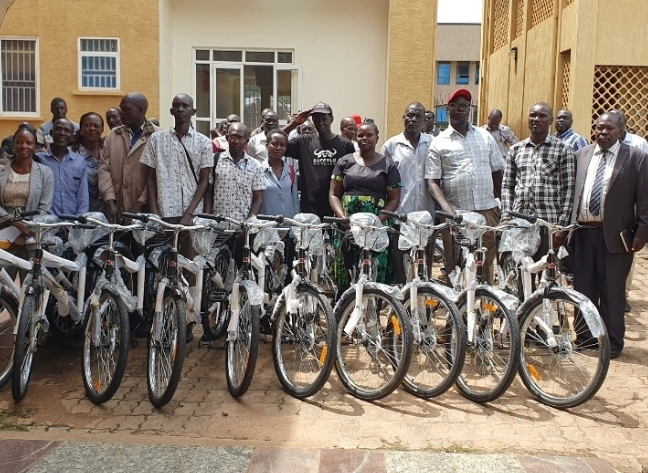

Lira, Uganda | The Ministry of Water and Environment, in partnership with World Bicycle Relief through Buffalo Bicycles Uganda Ltd, has distributed 37 bicycles to environment enforcement committees in Lira and Oyam districts to strengthen the protection and conservation of wetlands.

The handover ceremony, held at the Ministry’s regional office in Lira City, saw 19 bicycles allocated to Lira District, 14 to Barr Sub-county and 5 to Ayami Sub-county which fall under the Acwa and Moroto River Wetland Systems, and 18 to Oyam District.
Each bicycle, valued at UGX 730,000, is intended to facilitate mobility for environment monitors and promote timely reporting of wetlands encroachment.
Joseph Ongol, Assistant Commissioner for Wetland Management at the Ministry and former Lira District Environment Officer, urged enforcement committees not to delegate their responsibilities to the police.
He stated that the role of the police is to provide protection, not to carry out the work of environmental enforcement.
His remarks were made in response to concerns raised by Oyam District Fisheries Officer Etot Jimmy about the need for enforcement support.
Ongol noted that some enforcement officers had become complacent and had left their duties to law enforcement personnel.
He emphasized that environmental enforcement must be carried out by those assigned to do so and not transferred to the police.
He added that while police can provide security when needed, the primary responsibility remains with the environmental teams.
He encouraged the committees to use the bicycles to support both their work and domestic needs but cautioned against misuse.
He advised them to increase the frequency of wetlands surveillance and to actively report encroachment during their routine activities.
Ongol further recommended that officers should serve as advocates for wetlands conservation during public gatherings such as religious and community events and to collaborate with local leaders.
He emphasized the need for accurate and detailed reporting and advised that all reports of encroachment should be submitted to district environment offices for proper follow-up.
Ongol also warned the recipients against using the bicycles for illegal purposes that could get them into trouble.
Kilama Gabriel, Programs Manager at Buffalo Bicycles Uganda Ltd – Lira, said that the donation was part of a wider initiative supported by World Bicycle Relief aimed at improving service delivery in hard-to-reach areas.
He explained that the bicycles were intended to enhance mobility and increase the frequency of wetlands monitoring.
He pointed out that similar donations had been made in other sectors, including to Community Health Extension Workers (CHEWs) in Lira and Mayuge distrcts, and added that the effectiveness of the bicycles would be monitored.
Kilama said that while the bicycles could also support other domestic activities, they should primarily serve to improve wetlands protection.
He advised the committees to make efficient use of the bicycles and urged district officials to label them for accountability since they remain district property.
Lira District Environment Officer Walter Ocen welcomed the donation, describing it as a timely intervention that would address long-standing mobility challenges.
He said that all wetlands in the district had already been demarcated using beacons, with support from the Ministry, and that current efforts are focused on monitoring.
Ocen encouraged the beneficiaries to use the bicycles for the purpose they were intended and to submit timely reports.
He expressed hope that, if used properly, the bicycles could lead to future support, possibly in the form of motorcycles.
He added that minor cases of encroachment, such as tomato growing, could be handled at the grassroots level, while more serious cases should be referred to his office.
Oyam District Fisheries Officer Etot Jimmy, who represented Environment Officersaid, said that his district was facing a shortage of personnel for policy enforcement, which had hindered effective wetlands protection.
He noted the need for a trained, specialized environmental police unit to back up current operations, citing instances where enforcers had been arrested while executing their duties.
He explained that the lower enforcement teams had been facing challenges in reporting actual occurrences on the ground and expressed concern that some individuals, especially the wealthy and armed, continued to defy regulations.
Etot appreciated the support from RDCs, District Chairpersons, and Police Commanders in combating wetlands encroachment and called for prosecution of persistent offenders to serve as a deterrent.
Denis Onyanga, LCII Chairperson for Abunga Parish in Lira’s Bar Sub-county, said that demarcation of wetlands boundaries had made enforcement more effective.
He acknowledged that wealthy individuals often acted with impunity, making enforcement difficult.
Onyanga believed that the distributed bicycles would now enable enforcers to reach distant wetlands and conduct their work more efficiently.
Otim Bonny, Chairperson of the Parish Environment Committee in Aloni, Iceme Sub-county, Oyam, observed that many residents still lacked understanding of what constitutes a wetland.
He attributed continued cultivation in wetlands to low levels of public sensitization and pointed out that educated individuals tend to respond better to awareness efforts than the illiterate.
With Uganda’s wetlands increasingly under threat due to agricultural encroachment, particularly rice cultivation, the Ministry’s initiative is expected to enhance community-level monitoring and intervention.
Officials stressed that future support from development partners would depend on the commitment and performance of the recipients in fulfilling their environmental responsibilities.
