


Lira, Uganda | Lira University has unveiled its proposed UGX 46.1 billion Budget Framework for the 2026/2027 financial year, maintaining the same indicative figure as the 2025/2026 approved budget.
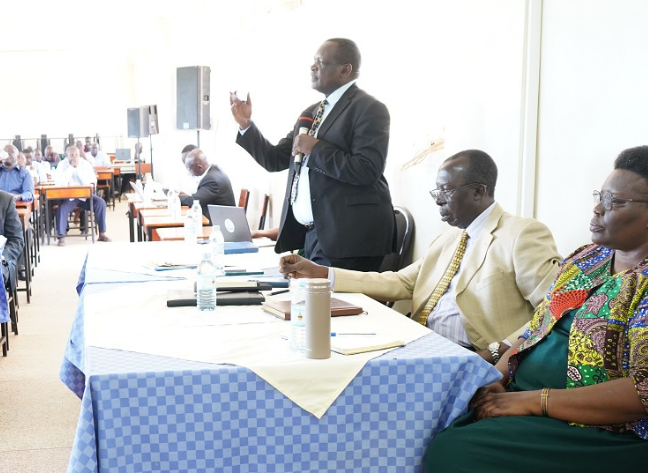
The budget was presented during a high-level Budget Conference held on 24 October 2025 at the university’s Public Hall, attracting members of the University Council, management, faculty heads, and stakeholders in the education sector.
Council Chairperson David Geoffrey Opiokello commended the university management for ensuring a transparent and collaborative budgeting process, saying the conference was crucial in aligning resources to institutional priorities, enhancing accountability, and strengthening financial planning.
Acting Deputy Vice Chancellor (Finance and Administration) and University Bursar, CPA Nathan Hagobi, presented the financial performance for the previous financial year and outlined strategic priorities for 2026/2027.
He reported that the FY 2024/2025 budget of UGX 39.2 billion was fully released by the Ministry of Finance, with the Government of Uganda contributing UGX 34.8 billion toward wage, non-wage, and development funding.
Non-Tax Revenue (NTR) collections stood at UGX 4.8 billion, representing 63.9% of the UGX 7.5 billion target. Key revenue sources included tuition fees, application fees, rental charges, and service-related income.
Hagobi noted that the current budget cycle has seen substantial gains in academic expansion, infrastructure development, and digital transformation, supported by government funding and development partners through research grants.
Lira University reported progress in the following areas:
● Academics: Increased student enrolment due to new programmes in health sciences, ICT, and education; successful examinations and graduation ceremonies.
● Digital Transformation: Expanded access to e-learning platforms and the digital library.
● Infrastructure: Completion of the main administration block, installation of solar security lighting, improvement of campus roads and drainage systems, and procurement of laboratory, ICT, and medical equipment.
● Service Delivery: Strengthened research and innovation, improved staff welfare, enhanced internet connectivity, and sustained community outreach programmes, including clinical services and medical camps.
Hagobi stated that the university’s performance demonstrated prudent financial management and laid a solid foundation for efficient implementation of the 2026/2027 budget.
The proposed budget seeks to consolidate gains and accelerate growth in line with Uganda’s Vision 2040, the Fourth National Development Plan (NDP IV), and sector priorities.
Key focus areas include:
● Strengthening resource mobilisation and revenue diversification
● Enhancing financial efficiency, accountability, and value for money
● Completion and operationalisation of major capital projects, including the Main Administration Block
● Expansion of academic programmes in science, technology, innovation, and health
● Strengthening ICT systems for digital transformation
● Promoting staff capacity development and welfare
● Advancing research, innovation, and community outreach
● Integrating climate resilience and sustainability into operations
CPA Hagobi appealed to the government to increase both recurrent and development funding to enable completion of lecture theatres, laboratories, staff housing, and other key infrastructure.
He also called for strengthened non-tax revenue mobilisation through consultancy services, short courses, and strategic partnerships.
He emphasised the adoption of Business Process Re-engineering to enhance administrative efficiency, promote performance-based budgeting, and ensure continuous monitoring and evaluation.
“The FY 2026/2027 Budget is not merely a financial document; it is a strategic roadmap for growth, innovation, and accountability,” Hagobi said, stressing the university’s commitment to transparency and value-driven resource use.
Heads of Faculties, Directorates, and Departments presented performance reports and priority needs for the coming year, while Council members reiterated the importance of collective responsibility and prudent financial management.
Council Vice Chairperson Ms. Nellie Florence Okullo, Audit Committee Chair Dr. Rosie Agoi, Finance Committee Chair Mr. Timothy Jokenne Okee, and Student Welfare Committee Chair Hon. Dickens Odongo were among the senior officials in attendance.
Lira University’s 2026/2027 Budget Framework positions the institution for sustained expansion, financial resilience, and global competitiveness.
