
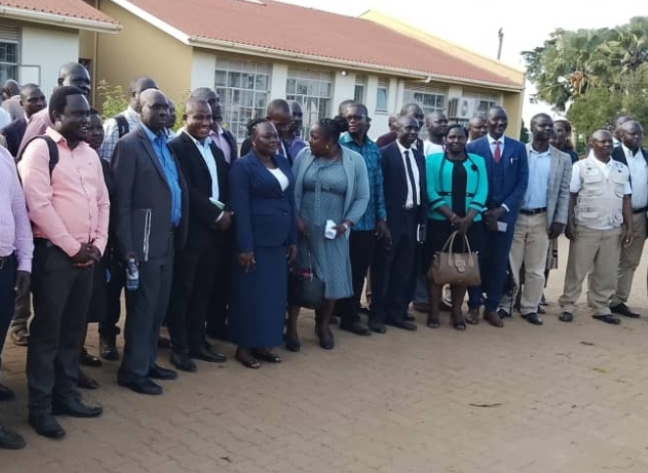

The Ministry of Agriculture, Animal Industry and Fisheries (MAAIF) has engaged stakeholders from 19 districts and cities across the Lango and Acholi sub-regions to strengthen the implementation of the Uganda Climate-Smart Agricultural Transformation Project (UCSATP).
The engagement, held on Thursday, November 19, 2026, at Ngetta Zonal Agricultural Research and Development Institute (Ngetta ZARDI) in Lira City, aimed at promoting inclusive planning, local ownership and coordinated implementation of agricultural investments under the project.
The meeting brought together district leaders, agricultural officers, researchers, and project officials to assess progress, identify implementation challenges, and discuss interventions to improve agricultural productivity, household incomes, and farmers’ access to markets.
Ogwang Michael, an engineer in MAAIF’s Department of Agricultural Infrastructure, Mechanisation and Water for Agricultural Production, said planned investments at Ngetta ZARDI would include an animal health and nutrition laboratory, a catfish hatchery, a solar dryer, a greenhouse, a maize crib and a tractor.
He said the institute’s seed laboratory and pump house would also be renovated to strengthen agricultural research and provide farmers with practical training in modern farming and irrigation technologies, noting that the facilities would support the development of improved crop varieties, boost agricultural productivity and contribute to efforts to address food insecurity.
Dr. Alfred Kumakech, Director of Research at Ngetta ZARDI, said the institute is scaling up the production of climate-resilient crop varieties, including improved beans, sorghum and clean cassava planting materials, alongside coffee seedlings and improved livestock technologies.
He said the planned irrigation, storage, solar-drying and fish hatchery facilities would strengthen seed production, improve the quality of agricultural products, reduce post-harvest losses and increase farmers’ access to affordable planting materials and fish fingerlings.
Meanwhile, Oola Donato Olam, the Chief Administrative Officer of Omoro District, said the project is expected to improve household incomes, agricultural productivity and market access, despite, low farmer co-funding, particularly in livestock enterprises, and delays in payment redemption as some of the challenges affecting implementation.
Samuel Dulson Okello, the UCSATP focal point person for Amolatar District, raised concerns over delays in planned infrastructure investments, inadequate operational funding and delayed delivery of motorcycles intended to support agricultural extension workers in their field activities.
Odongo Kizito, Principal Agricultural Officer at MAAIF, said several farmer groups had been profiled, with validation and the creation of digital wallets underway to facilitate access to agricultural inputs through the Electronic Voucher Management System.
However, he identified the mandatory 20% farmer co-funding requirement and unpredictable weather patterns as key challenges facing the project.
The Uganda Climate-Smart Agricultural Transformation Project seeks to strengthen agricultural production and resilience through improved technologies, climate-smart farming practices, infrastructure development, and enhanced access to agricultural inputs.