
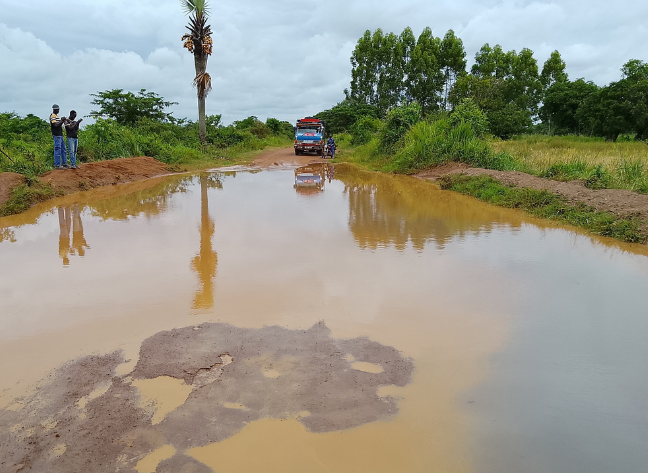

Members of Parliament have called for urgent government intervention to address deteriorating road infrastructure in the Lango sub-region, with renewed attention on the long-awaited tarmacking of the 88-kilometre Dokolo–Ochero–Namasale road.

The call followed a field inspection by Parliament’s Committee on Physical Infrastructure, which visited several road projects in Lango on Thursday, November 12, 2026, to assess their condition and establish the progress of government interventions.
Eng. William Taylor Tiyo Odaa, the Ayivu East Division MP and Vice Chairperson of the committee, said the visit was part of Parliament’s nationwide assessment of major infrastructure projects.
He said the committee was particularly interested in the Dokolo–Ochero–Amolatar road, whose tarmacking President Yoweri Museveni pledged during the recent presidential campaigns.
Tiyo Odaa explained that the project had initially been planned under the Third National Development Plan (NDP III) before being rolled over to NDP IV.
He added that the President had renewed his commitment to the project during a meeting with the committee at State House Entebbe on October 28, 2026, promising to fast-track its implementation.
Kioga North MP Geoffrey Ocen Kiring, who’s a member of the committee, said the poor road network in Amolatar District is worsening the cost of doing business and limiting access to essential services, particularly healthcare.
Ocen noted that Amolatar, being a peninsula without a general hospital, depends heavily on Lira Regional Referral Hospital for specialised medical services, but poor roads make referrals more expensive and difficult.
He said some patients are forced to use longer alternative routes, increasing transport costs and delaying access to medical attention.
The MP said the Dokolo–Ochero–Namasale road had been earmarked for tarmacking following a presidential directive in 2021, but implementation had not materialised.
He disclosed that the Ministry of Works and Transport was undertaking a fresh survey after the previous assessment expired, adding that China Seventh Group had reportedly been identified to undertake the works.
Ocen also revealed that the proposed 15.2-kilometre Atingi–Olik Swamp–Corner Namubere road rehabilitation contract had reached the Solicitor General’s office for clearance.
He said the committee’s findings would provide further justification for the government to prioritise the projects.
Meanwhile, Ajuri County MP Fred Jalameso raised concerns over the poor state of road infrastructure and inadequate facilities at some of the country’s airports and aerodromes ahead of the 2027 Africa Cup of Nations (AFCON).
Jalameso singled out Gulu Airport, which he said had some of the poorest facilities, including a murram runway and an inadequate aircraft apron.
He also described Alebtong District’s road network as among the worst in the country, recounting how the committee’s vehicle got stuck twice while inspecting the Abako road.
The MP said the Lira station engineer had committed to deploying road equipment to the Abako–Dokolo road after completing works on the Dokolo–Ochero–Namasale road.
At the local government level, Awelo Sub-county LCIII Chairperson George Okello appealed to the committee to prioritise rehabilitation of damaged sections of the Atingi–Corner Namubere road.
Okello said the deteriorating road conditions were affecting residents’ access to essential services and appealed for the extension of improvement works towards Awelo Secondary School, approximately half a kilometre from the existing road section.
The committee’s inspection also took it to Lira Railway Station, where members assessed ongoing rehabilitation works amid complaints from some residents who had settled on Uganda Railways Corporation land and now face possible eviction as government moves to revive railway transport.
The team had earlier inspected the Abako–Dokolo road in Alebtong before proceeding to Amolatar District, where it assessed the Dokolo–Ochero–Namasale and Atingi–Olik Swamp–Corner Namubere roads.
The legislators later travelled back to Kampala through the Namasale ferry, concluding their field assessment of the infrastructure projects in the sub-region.