
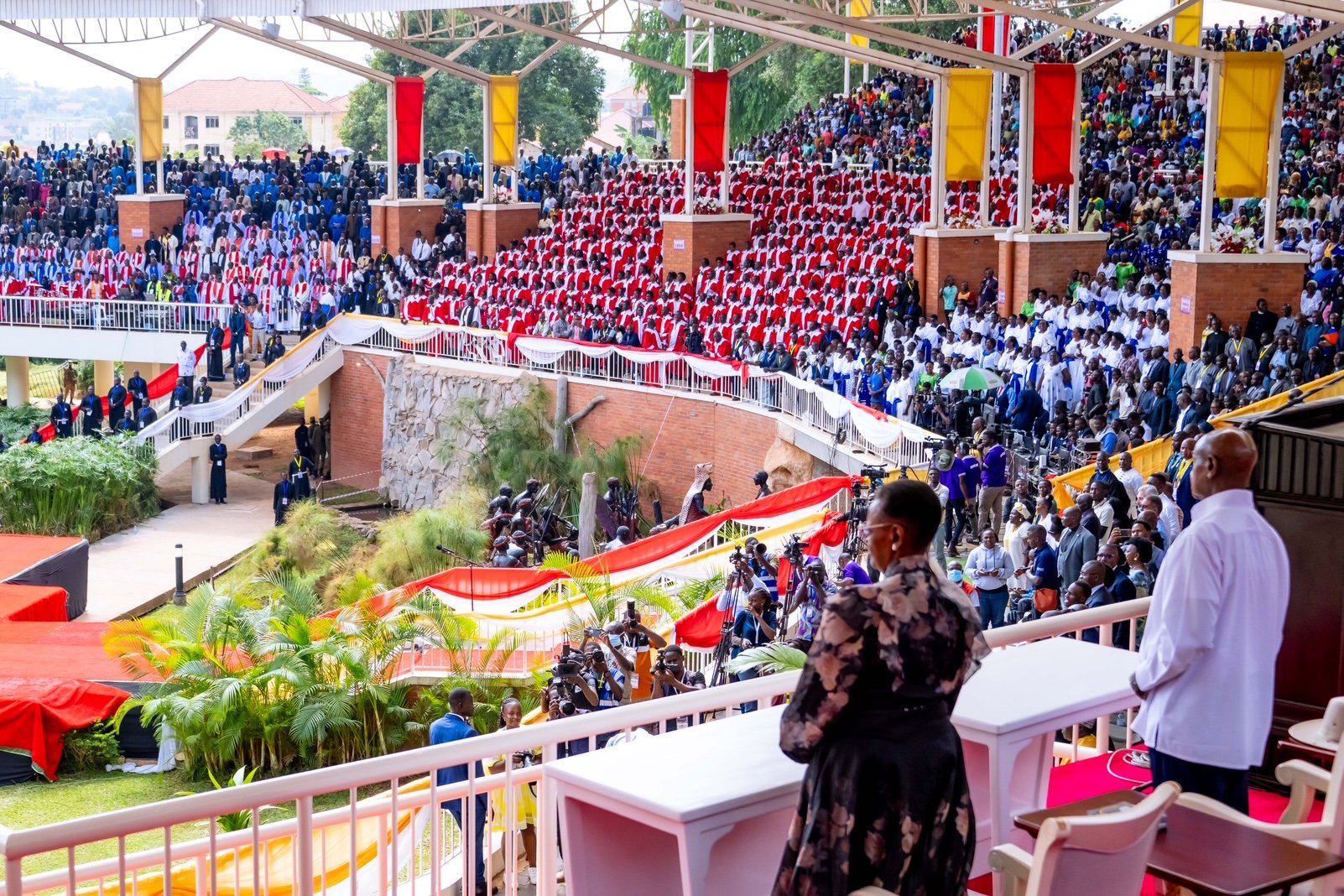

Namugongo, Uganda | President Yoweri Kaguta Museveni has directed that government contributions towards Uganda Martyrs Day celebrations be permanently included in the national budget, following this year’s disbursement of UGX 4.2 billion to support the event.

While addressing thousands gathered at the Namugongo Anglican Shrine for the 140th anniversary of the Uganda Martyrs, President Museveni announced that the Catholic and Anglican churches had each received UGX 2 billion, while the Muslim community received UGX 200 million.
He said these contributions would henceforth become part of the government’s annual financial planning, citing the historical and spiritual significance of the Martyrs Day to Uganda’s identity.
Museveni stressed that Uganda’s peace and spiritual unity required consistent government support for all major religious groups.
He also reflected on his experiences during the liberation war, saying that he had lived among communities composed of Anglicans, Muslims, Catholics, and adherents of traditional beliefs.
He noted that most individuals often combined christian and traditional practices and said he did not judge them unless their actions posed a danger to life.
The President added that during that period, unity had been fostered through the sharing of scientific knowledge rather than religious condemnation.
On national values, Museveni advised Ugandans to refrain from mixing religion with politics.
He said politics concerned their well-being on earth, whereas religion dealt with the soul and the life after death.
He reiterated that denominational loyalty should not influence political choices.
Vice President Jessica Alupo, who represented the President at the Catholic Shrine, conveyed a message encouraging all Ugandans—regardless of faith—to show their support for President Museveni in the upcoming general elections scheduled for January.
She said that by the time they return for next year’s Martyrs Day, it would be expected that christians, muslims, and all Ugandans would have demonstrated this support at the polls.
At the Catholic shrine, Archbishop Paul Ssemogerere used his homily to call for political maturity and national cohesion.
He appealed for a Uganda where political competition should not translate into enmity, where elections do not lead to unrest, and where leadership is judged by the quality of service rather than the amount of power held.
He further reminded the nation that the Uganda Martyrs had become symbolic voices of faith and sacrifice, stating that their wounds spoke louder than words and stood as a testament that faith was rooted in conviction, not comfort.
Meanwhile, the Anglican celebrations, led by the Northern Cluster, featured a sermon from former Archbishop of the Church of Uganda, Rt. Rev. Dr. Henry Luke Orombi.
He expressed concern about the growing moral decay in society, stating that removing God from national affairs would cause the country to lose its moral compass.
He lamented that many people were now treating fellow citizens as objects and that the spilling of blood no longer disturbed the conscience of the nation.
Orombi also praised the Martyrs’ extraordinary courage, stating that they praised God even in the flames as though fire were harmless.
He said they were fully aware of the pain they faced but remained focused on the eternal glory that awaited them.
Despite the large attendance at the shrines, several vendors operating outside the Catholic site voiced dissatisfaction over poor sales.
They reported that customer numbers were low despite paying high rental fees ranging between UGX 100,000 and UGX 300,000, depending on the stall location.
The Uganda Martyrs were 45 young Christian converts—22 Catholic and 23 Anglican—who were executed on the orders of Kabaka Mwanga II between 1885 and 1887 for refusing to abandon their faith.
Their legacy remains deeply embedded in Uganda’s religious and cultural history.