

The government has been urged to promote greater use of Alternative Dispute Resolution (ADR) as a way of easing the growing burden on Uganda’s courts and reducing the time and cost associated with litigation.

Dr. Harry Mwebesa, an associate professor and chief executive officer of Reconciliation Trust International, said many disputes could be resolved through dialogue and negotiation before parties resort to court.
Mwebesa said Reconciliation Trust International has trained nearly 900 people across Uganda in ADR, adding that some disputes that have remained in court for years can be resolved within minutes when the parties are encouraged to negotiate. He said ADR provides an opportunity for disputing parties to reach mutually acceptable settlements while reducing pressure on the formal justice system.

Bernard Bonn Acuma, the Cohort Two coordinator, said 16 graduates had completed a two-month ADR training programme that included practical exposure to courts and prisons.

Acuma said the graduates would be attached to courts across the sub-region to support efforts to clear case backlogs through mediation, negotiation, and arbitration. He said the second cohort initially had 20 trainees, but only 16 completed the programme, while 22 of the 28 trainees in Cohort Three graduated, bringing the total number of graduates to 40.
Nickson Ojota, the Cohort Three coordinator at Reconciliation Trust International, said the organisation is committed to producing competent professional mediators capable of handling civil disputes in accordance with the law.

Ojota said the mediators handle matters, including land conflicts, commercial disputes, and arbitration, adding that they conduct fact-finding at the scene of disputes and consult cultural and community leaders before presenting consent agreements to court. He said mediation is faster and less costly than conventional litigation and promotes harmony because disputing parties are able to reach a win-win settlement. However, Ojota noted that serious criminal cases such as murder, robbery, and treason remain subject to formal court processes.
Alebtong District LCV chairperson Ambrose Ongom Ongom said conflicts are inevitable in society but warned that unresolved disputes could result in destruction of property, broken relationships and loss of lives.

Ongom said Alebtong had registered 25 civil cases and urged residents to embrace reconciliation and ADR as a means of resolving conflicts peacefully. He also commended parents and guardians who had supported their children to acquire ADR skills, describing the investment as valuable to the community because the trained mediators would help promote peace and resolve disputes.
Lango Cultural Institution Minister of Justice Simon Peter Odoo, who represented the Paramount Chief (Won-Nyaci) of Lango, called for more training of cultural leaders involved in ADR.
Odoo said a one-day training session held at Margarita Palace Hotel several months ago was inadequate to equip cultural leaders with the skills required to effectively handle disputes. He said cultural institutions have clan-based mediators known as Itogo, who handle disputes within their clans but lack adequate training in professional mediation.
Odoo urged thejudiciaryy and other justice-sector institutions to provide specialised training for Itogo and Owitong, stressing that mediators should remain neutral and allow parties to voluntarily reach agreements instead of imposing decisions on them.
He also cautioned mediators to maintain integrity and impartiality, saying their position as community role models requires them to avoid taking sides or becoming part of the disputes they are expected to resolve.
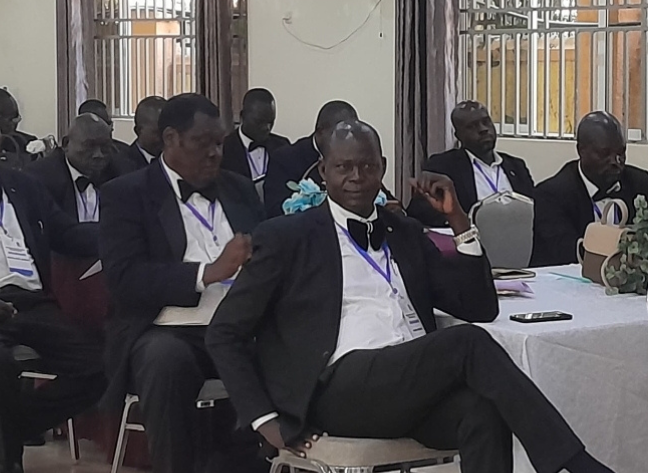
The remarks were made on Friday, September 11, 2026, during the graduation of 40 ADR mediators at Pauline Hotel in Lira City.