
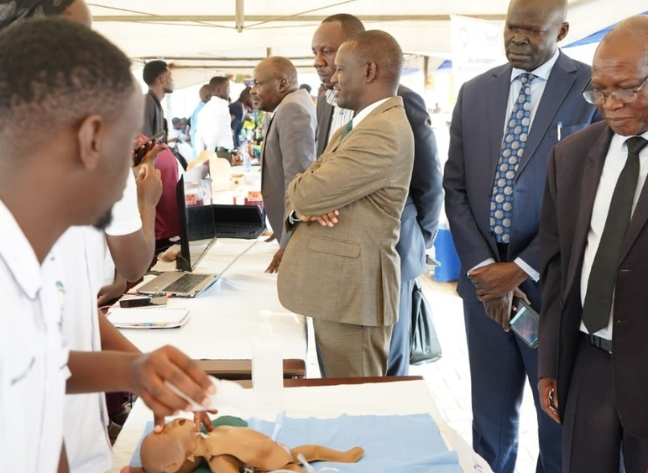

Lira, Uganda | Lira University has partnered with the Forum for African Women Educationalists (FAWE) Uganda Chapter to expand access to higher education through the Higher Education Access Certificate (HEAC) programme, with 23 students already benefiting from bursary support.
The development was revealed during a consultative meeting held on April 22, 2026, at the university’s Faculty of Public Health boardroom, where FAWE Uganda Executive Director Susan Opok Tumusiime said the initiative is being implemented in partnership with the Mastercard Foundation across selected institutions in the country.
Tumusiime noted that the programme is designed to support disadvantaged youth, particularly girls, refugees, and persons with disabilities, by offering bursaries and remedial “bridging” courses. She explained that the aim is to create pathways for learners who would otherwise miss out on tertiary education to transition into university and eventually secure employment or start their own ventures.
She added that the initiative focuses on increasing equitable access to higher education and ensuring that no capable learner is left behind due to financial or academic limitations.
Lira University Acting Vice Chancellor, Dr. Andrew Ojulong commended FAWE Uganda for supporting the HEAC programme, describing it as a critical intervention for students who do not meet direct entry requirements for degree programmes.
He revealed that the National Council for Higher Education accredited the university’s HEAC programme in April 2024, paving the way for its implementation.
Ojulong said the university management was impressed by the scope and focus of the HEAC programme, noting that it supports young people who have completed secondary education but lack the qualifications or means to join university.
The Deputy Dean of the Faculty of Education, Gad Kwizera, said the university admitted 133 students in the inaugural 2025/2026 HEAC intake, with learners enrolled under Physical and Biological tracks.
Kwizera added that admissions for the 2026/2027 academic year are ongoing, with the introduction of a HEAC-General track aimed at widening opportunities for prospective students.
He, however, appealed for more support, urging FAWE Uganda to link the university to potential donors who can assist in strengthening e-learning infrastructure and laboratory facilities.
Kwizera said there is also a need to increase the number of mentors, especially male mentors, to improve the mentor-mentee ratio and enhance student support.
The HEAC programme is increasingly being viewed as a vital bridge for students seeking a second chance at higher education, particularly those from marginalized backgrounds.