
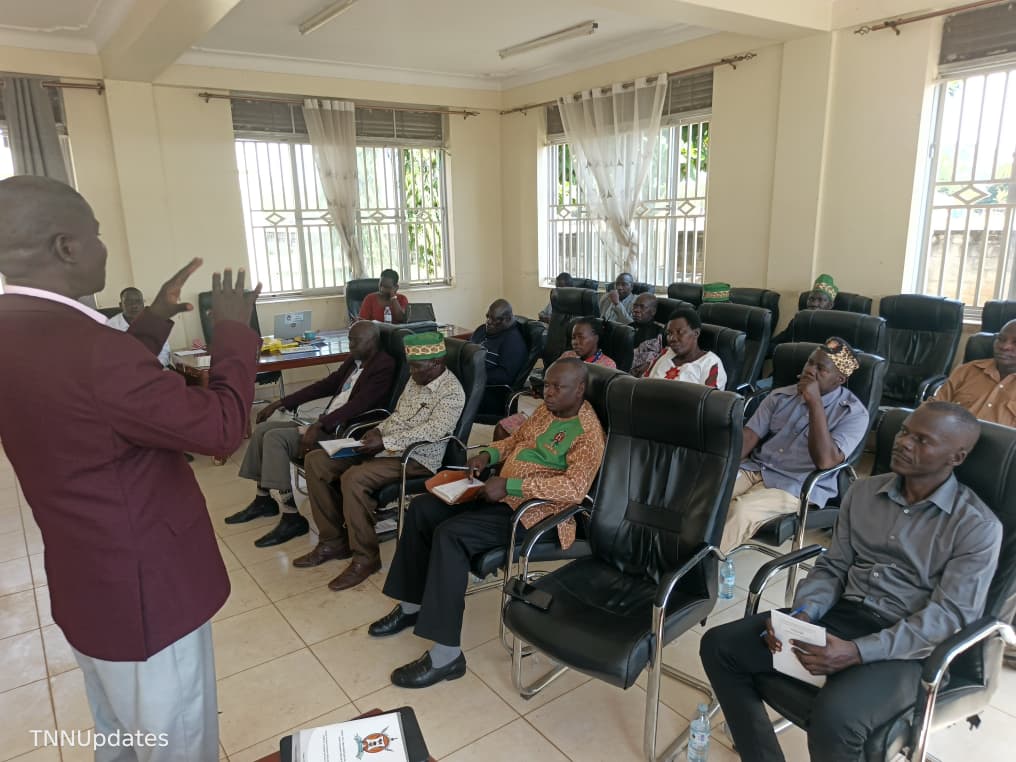

Soroti, Uganda | The Land and Equity Movement in Uganda (LEMU) has formally re-engaged the Kumam Cultural Heritage institution in a renewed drive to strengthen the protection, governance, and administration of customary land, with a particular focus on mediation, documentation of indigenous land rules, and safeguarding the rights of vulnerable groups such as widows and orphans.
The renewed engagement was announced in Soroti by Dr. Theresa Auma Eilu, LEMU’s Executive Director, during a high-level meeting that brought together leaders of the Kumam Cultural Heritage, civil society organisations, and development partners working on land justice in the Teso sub-region.
Dr. Eilu described the engagement as a continuation of a long-standing partnership dating back to 2008, when LEMU worked with the Kumam Elders Forum to document customary land governance rules.
“Today I am very happy to restate our re-engagement with the Kumam people on protecting customary land. This is not new work,” Dr. Eilu said. “As far back as 2008, LEMU worked with the Kumam Elders Forum, and one of the most important achievements was the documentation of customary land rules.”
Dr. Eilu noted that the earlier collaboration laid a strong foundation, but the formal establishment of the Kumam Cultural Heritage as a recognised cultural institution has opened new avenues for deeper and more structured engagement.
“Now that the Kumam Cultural Heritage is in place, there have been important institutional changes,” she said. “We are re-engaging to work directly with the cultural institution, and we have agreed on key priorities, including reviewing and updating the rules governing land management within Kumam territories.”
She said the renewed collaboration will focus on revising documented customary land rules, strengthening partnerships with key stakeholders, and deliberately addressing land injustices faced by widows, orphans, and other vulnerable community members who are often targeted by land grabbers.
Dr. Eilu emphasised that LEMU’s engagement on customary land should be understood as a long-term programme rather than a short-term project.
“This is not a project; it is a programme,” she said. “Land challenges are persistent. If we treat this as a one-year project, what happens after that year? As long as we can mobilise resources, we will continue this work.”
She also underscored the legal legitimacy of customary land governance, citing the 1995 Constitution of Uganda, which recognises customary tenure as one of the country’s lawful landholding systems.
The Land Act, she added, provides that customary land shall be governed according to rules that are socially acceptable to the relevant community.
“In this case, the community is the Kumam,” Dr. Eilu explained. “They have documented rules that are socially acceptable to them. Those rules carry legal weight, and communities are acting fully within the law.”
Mediation remains a central pillar of LEMU’s approach to land justice. Dr Eilu acknowledged that clan leaders increasingly face hostility, intimidation, and marginalisation when handling land disputes.
“Clan leaders are telling us this work is difficult and sometimes life-threatening,” she said, referencing recent engagements with the Ministry of Lands. “They are abused, ignored, and sometimes told by powerful individuals, ‘Who are you?’”
She argued that mediation offers a more inclusive and less destructive approach to resolving disputes compared to litigation.
“When you mediate, there is no winner and no loser,” Dr. Eilu said. “In court, there must be a winner and a loser. If people can talk, why should they begin by fighting?”
She acknowledged that customary norms and statutory law do not always align but noted that Ugandan law provides space for mediation and recognises customary systems as a legitimate starting point for dispute resolution.
Speaking on behalf of the Kumam Cultural Heritage, Ekilu Peter, the institution’s Deputy Prime Minister, described land as a deeply sensitive issue across all communities and welcomed LEMU’s technical support.
“Land is a big issue in every tribe,” Ekilu said. “LEMU is helping us to equip our people to resolve land disputes amicably, starting from the lowest level.”
He said the meeting had produced concrete action points, including reviewing the Kumam land governance book and conducting training and sensitisation for clan leaders—locally known as Wegi Bukui—across all levels of the cultural structure.
The meeting was also attended by Moses Elilu, Programme Manager at Redeem International, who highlighted the importance of law enforcement in addressing land grabbing.
“Redeem International believes that enforcement creates deterrence,” Elilu said. “We work with government partners to ensure perpetrators of land grabbing, especially against widows and orphans, are held accountable.”
He noted that mediation sometimes fails due to limited technical capacity, lack of trust, or conflicts of interest, making it necessary to establish clear referral pathways to formal justice mechanisms when dialogue breaks down.
Robert Ewangu, a founder member of the Kumam Cultural Heritage, described the renewed partnership as timely amid rising land disputes in the region, particularly during the rainy season when boundary conflicts intensify.
“We want LEMU to help train clan leaders, strengthen our clan directorate, and guide us in rewriting the Kumam PPRR book,” Ewangu said.
The PPRR—Principles, Responsibilities, and Rights—framework forms the backbone of customary land governance among the Kumam and is expected to be updated to reflect current realities while preserving indigenous values.