

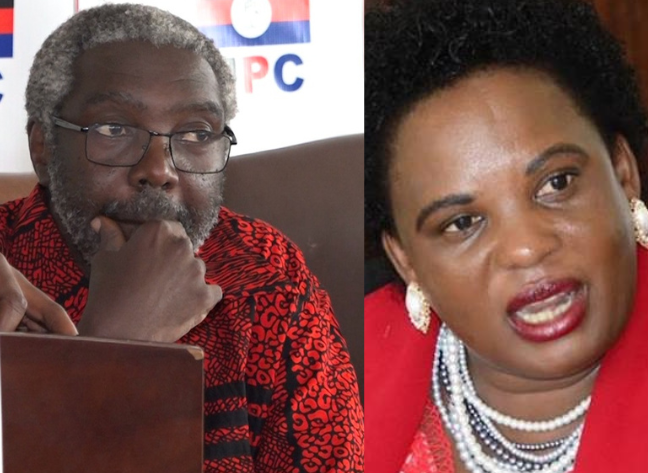
Lira, Uganda | Political leaders and senior party members in Lango Subregion have strongly rejected Uganda People’s Congress (UPC) president Jimmy James Michael Akena’s call on supporters to write his name on the presidential ballot paper, warning that the move risks invalidating votes and isolating the region from national development.

Speaking at a press briefing on Friday at Gracious Palace Hotel in Lira City, Joel Okao Tema, the FDC Chairperson for Lira District and a former parliamentary candidate for Erute South, described Akena’s remarks as reckless, unconstructive, and politically irresponsible.
He said that while Akena has a constitutional right to challenge his exclusion from the presidential ballot, urging voters to deliberately spoil ballots is the wrong approach and add no value to the electorate.
He argued that Lango should actively participate in peaceful elections aimed at securing development rather than engaging in actions that promote division and political frustration.
Okao Tema added that Akena bore personal responsibility for failing to appear on the ballot and should take accountability instead of blaming others or attempting to mobilise protest votes.
He warned that such statements could derail Lango’s recovery efforts, noting that the region is still rebuilding more than two decades after insurgency-related devastation.
He also accused Akena of contributing to the recent growth of the NRM in Lango through past political decisions and said he could not now turn around and attempt to demobilise the same population by appealing to UPC’s historical dominance in the region.
Jimmy Awany, also known as Cing Malu, a long-serving UPC member, traced Akena’s political journey back to 2005 when he first contested for Lira Municipality Member of Parliament.
Awany said party members had expected Akena to contest for presidency in 2011, but he did not, a decision that later saw Dr. Olara Otunnu fly the UPC flag instead.
He noted that similar expectations were raised in 2016 and 2021, but again Akena did not contest, citing party restructuring.
Awany questioned why Akena had repeatedly failed to offer himself for the presidency yet now sought sympathy after missing the 2026 ballot.
Awany also cited what he described as a political alliance between Akena and the NRM government, pointing to the appointment of Akena’s wife, Betty Amongi, as a cabinet minister.
He argued that UPC members retain the constitutional right to vote for candidates of their choice and expressed confidence that many in Lango would support President Yoweri Kaguta Museveni, whom he described as having a clearer development vision among the eight candidates.
Awany challenged Akena to demonstrate political consistency by asking his wife to resign from government if he truly opposed NRM leadership.
UPC member Okwir Jaramogi also criticised Akena’s directive, saying it undermined democratic participation and disrespected both the party and voters.
He said Lango could not afford to isolate itself from the national agenda and warned that invalid voting would sabotage the region’s aspirations for new districts, infrastructure development, and an airport.
Jaramogi noted that while Akena carries the historical legacy of being born to former president Apollo Milton Obote, that privilege should not be used to bring embarrassment to the Obote family, UPC, or the country.
He stressed that UPC belongs to the people of Uganda and not to any individual, adding that leadership mistakes should not be passed onto voters.
Earlier this week, Akena urged supporters to write his name on the January 15 presidential ballot as a show of solidarity after he was blocked from nomination following a court ruling that questioned his legitimacy as UPC president.
However, the Electoral Commission dismissed the call as misleading and irresponsible.
EC spokesperson Julius Mucunguzi warned that writing names on ballot papers would only result in invalid votes, saying such actions amounted to abusing the voting process and wasting public resources invested in organising the election.
The Commission reiterated that only duly nominated candidates whose names appear on the ballot are eligible to receive votes.
The Lango leaders jointly called on elders and cultural leaders (Itogo) to intervene and encourage dialogue, urging Akena to calm down and prioritise unity.
They encouraged voters to exercise their constitutional rights peacefully and wisely, warning that protest voting could cost Lango future development opportunities.
Okao Tema said the election should be about national transition, development, and unity, rather than one individual’s frustration or ego.
