


By Haron Okwir
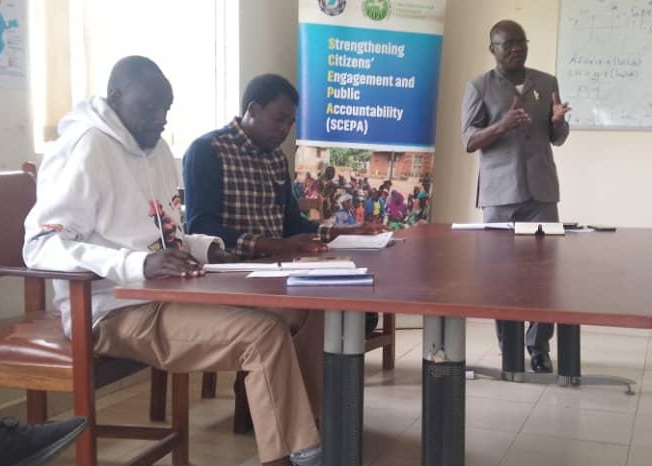
Otuke, Uganda | Facilitation for Peace and Development (FAPAD) has held a high-level strategic meeting with key stakeholders in Otuke District under the “Strengthening Citizens’ Engagement and Public Accountability (SCEPA)” project, aimed at revitalizing citizen participation in governance and service delivery.
The meeting, held on Thursday, June 19, 2025, at Otuke District Headquarters, brought together a wide range of participants, including the Resident District Commissioner (RDC), District Internal Security Officer (DISO), Chief Administrative Officer (CAO), the Vice District Chairperson, heads of departments, local leaders, farmers, elders, cultural and religious leaders.
According to Dikan Grace Patricia, the Project Officer at SCEPA, the meeting aimed to identify and address emerging challenges in key sectors such as education, health, agriculture, infrastructure, security, water, and sanitation.
She explained that the project is designed to ensure that organized community groups, particularly the youth, women, and other marginalized populations, are empowered and equipped to meaningfully engage in decision-making processes.
Patricia noted that the initiative is not just about identifying issues but also about facilitating community-driven solutions through active and informed participation.
District leaders expressed their appreciation and pledged support for FAPAD’s initiative.
Chief Administrative Officer, Joseph Lomongin, acknowledged that Otuke District is grappling with several pressing needs, especially in the education and health sectors.
He observed that while the aspirations of the people are high, financial resources remain inadequate to meet these demands.
Lomongin also decried the limited number of schools in the district, pointing out that children are forced to walk long distances to access education, unlike in other areas with more facilities.
Vice Chairperson Ismael Opio emphasized the urgent need to establish more health facilities in the district.
He cited sub-counties like Ogwete and Got-Ojwang where residents still have to walk long distances to receive medical attention, a situation he said must be addressed to improve health service delivery.
District Health Officer, Patrick Opio, outlined a number of challenges facing the health sector.
He said many health facilities in Otuke are frequently affected by drug stock-outs, poor time management among staff, and lack of essential infrastructure.
He also highlighted malaria as the leading health threat to communities in the district.
Assistant RDC Isaac Opio Opeo noted that in line with the government’s socio-economic transformation agenda, the district leadership and the production department recently distributed goats to farmers to support livelihoods.
He added that the Office of the RDC has been actively involved in improving education infrastructure, having recently commissioned more than six classrooms in various parts of Otuke.
FAPAD is implementing the SCEPA project in the Lango Sub-region on behalf of the Uganda National NGO Forum, which coordinates the initiative across 14 different sub-regions through local partners.
The meeting concluded with a renewed call for stronger collaboration among civil society actors, government agencies, and local communities to enhance development, accountability, and inclusive participation.
