
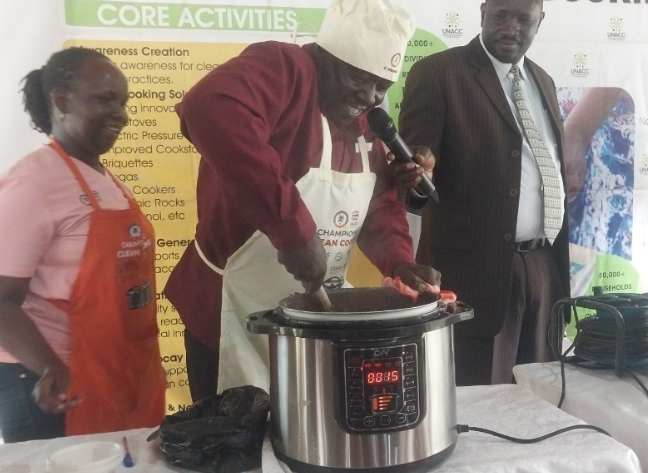

Lira, Uganda | Uganda’s national effort to transition households and institutions to clean cooking technologies gained momentum on Tuesday, June 17, 2025 as the National Renewable Energy Platform (NREP), in partnership with the Ministry of Energy and Mineral Development and UKaid, held a stakeholder engagement and outreach campaign at the Lira City Council Hall.

The campaign aims to reduce reliance on traditional biomass fuels, which continue to pose serious environmental and health challenges across the country.
Mariah Kizza, an official from the NREP, highlighted that 88% of Ugandans still use traditional cooking methods, primarily firewood and charcoal.
Only 2% of the population uses electricity for cooking, while 10% rely on fossil fuels such as liquefied petroleum gas (LPG) and kerosene.
She revealed that Uganda’s annual demand for wood fuel and charcoal stands at 53 million tonnes, yet the sustainable supply is limited to 26 million tonnes.
This demand is projected to increase by 4.2% annually due to population growth and urbanisation.
Kizza noted that beyond the strain on forests, traditional cooking methods are associated with severe health risks, especially indoor air pollution, which disproportionately affects women and children.
She stated that electric cooking (e-cooking) provides a safer, cleaner, and more economical alternative.
Speaking at the event, Lira City Town Clerk Vincent Okurut urged participants to advocate for environmental conservation within their communities.
He attributed the increasingly harsh weather conditions experienced during recent dry seasons—including intense heat—to environmental degradation caused by deforestation.
Okurut called on the public to take personal responsibility for protecting the environment through cleaner energy choices.
Under Uganda’s third National Development Plan (NDP III), the government seeks to reduce biomass usage for cooking from over 80% in 2020 to 50% by 2025.
The Ministry of Energy, under the leadership of Minister Ruth Nankabirwa, is spearheading this target through initiatives that promote access to modern cooking technologies.
The clean cooking programme is supported by development partners, including UKaid, Modern Energy Cooking Services (MECS), and the Uganda National Alliance on Clean Cooking (UNACC).
As part of the Lira campaign, energy-efficient EKOPOT 6L 1000W Electric Pressure Cookers were handed over to key city officials, including the Resident City Commissioner (RCC), Mayor, Town Clerk, Police Public Relations Officer, and the City Environment Officer.
These symbolic handovers were intended to set a precedent for institutional adoption of clean cooking technology.
Leonard Otika, the City Environment Officer and focal person for energy programmes in Lira, reported that four schools—St. Gracious Schools, Lango College, Saving Grace Nursery and Primary School, and St. Katherine Girls Secondary School—have expressed interest in switching to clean energy cooking systems, particularly biogas.
He urged other institutions to follow suit and stressed that transitioning to modern cooking methods would help reduce deforestation, expand forest cover, and mitigate climate change effects.
Otika emphasized that decentralising e-cooking to rural communities is vital, as these populations are most vulnerable to the dangers associated with traditional fuel use.
He explained that an electric pressure cooker can prepare a full meal using only half a unit of electricity, costing approximately UGX 400.
The clean cooking awareness tour, which has already been held in Soroti, Mbale, Mbarara, Gulu, and Jinja, aims to build momentum across urban and rural Uganda.
However, Thomas Otema, Director of St. Thomas Primary School welcomed the campaign but raised concerns about limited rural electrification.
He said many schools outside urban centres still lack reliable power, making adoption difficult.
Okello Tom Richard, Director of Studies at Lira Police Primary School, described the financial burden associated with firewood use.
He disclosed that the school spends about UGX 4.5 million each term on three lorry trips of firewood, often sourced from distant areas like Masindi due to deforestation in Lango.
He noted that the school’s cooks, many of whom have served for years, suffer from health complications related to prolonged smoke exposure.
He described the campaign as timely and beneficial but appealed to the government to subsidise electric pressure cookers, particularly for public institutions.
He also called for investment in electricity infrastructure to ensure consistent supply.
He explained that Lango Sub-region, once home to vast indigenous forests, has seen massive tree loss due to urbanisation and past conflicts such as the Lord’s Resistance Army (LRA) insurgency, which pushed communities to clear land for survival.
Participants agreed that clean cooking adoption must be a collective responsibility involving cultural, religious, political, and civil leaders.
They also urged institutional kitchens to transition to clean energy, which would significantly reduce exposure to smoke, lower costs, and contribute to environmental recovery.
The Lira City campaign reinforced Uganda’s commitment to sustainable energy solutions and demonstrated that behaviour change, government support, and strong partnerships are key to achieving national clean energy goals.