
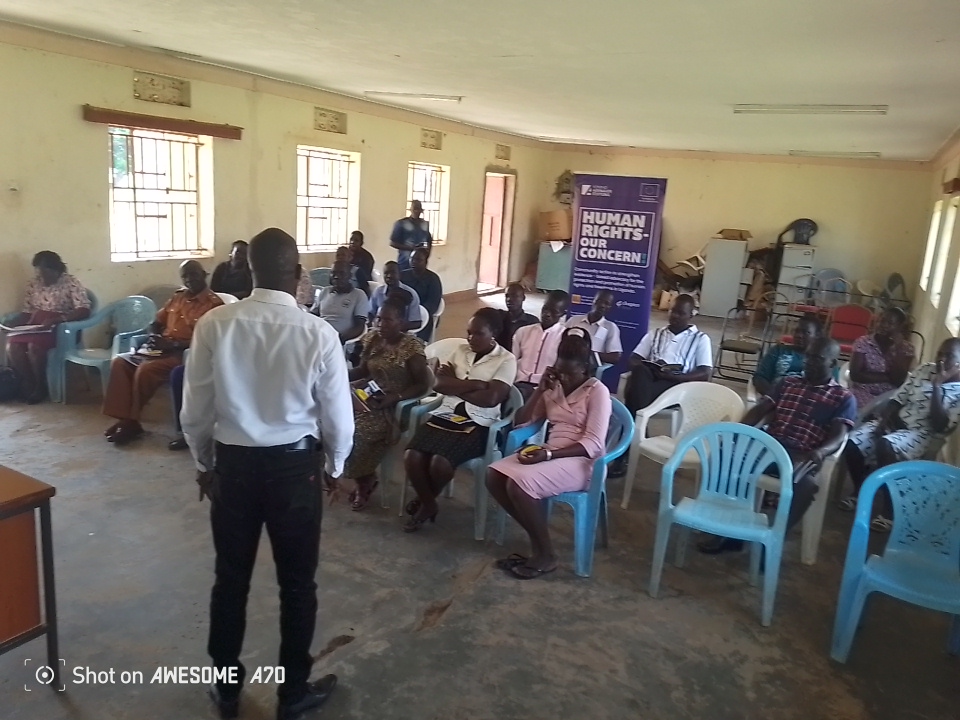

Otuke, Uganda | Stakeholders in Otuke District have called for stronger community and institutional collaboration to address recurring human rights violations, during a dialogue convened by Konrad Adenauer Stiftung (KAS) under its project “Human Rights, Our Concern.”
The engagement, held at the District Council Hall, brought together human rights defenders (HRDs), civil society actors, local government officials, and media practitioners to deliberate on emerging human rights challenges in the district.
According to Samson Okurut, the KAS project is currently being implemented in 14 districts across Uganda, with the goal of promoting localized dialogue and a responsive human rights culture.
“When discussions happen at the local level, people are able to identify recurring violations and propose practical solutions. That’s how human rights protection becomes sustainable,” Okurut said.
Participants identified several pressing issues, including gender-based violence (GBV), land grabbing, electoral violence, corporal punishment in schools, and poor prison conditions.
Brenda Akullo, the District Probation Officer, decried the poor state of accommodation and sanitation facilities at Otuke Prison, describing them as “unfit for human dignity.”
“Inmates face congestion and lack basic facilities. This amounts to a violation of their fundamental rights,” Akullo said.
She also raised concern over persistent corporal punishment in schools and overcrowded dormitories, where “three pupils sometimes share a single bed.” Akullo appealed to school administrators to adopt child-friendly disciplinary methods and improve learning conditions.
“Poor parenting in our communities is another silent human rights issue. Children are left to fend for themselves, which affects their growth and development,” she added.
Sylvester Ocen, the Senior Community Development Officer, echoed the concerns, pointing out that gender-based violence, domestic violence, and land disputes remain the leading causes of human rights abuses in Otuke.
“Community members often mediate serious criminal cases such as defilement and domestic violence, instead of reporting them to police. This undermines justice and encourages impunity,” Ocen warned.
He urged for consistent sensitisation and joint interventions involving civil society, local leaders, and government agencies to strengthen human rights protection in the district.
“If we work together and build awareness at the grassroots, we can gradually reduce the violations that continue to affect our people,” Ocen noted.
Ocen also lauded Konrad Adenauer Stiftung for sustaining its partnership with the district leadership and promoting open dialogue on human rights concerns.