
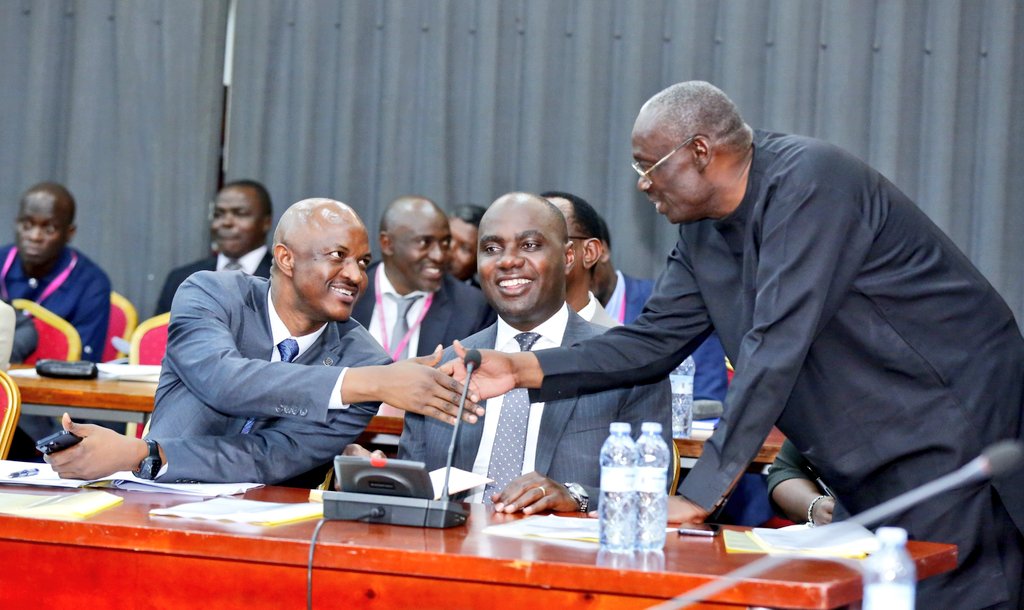

Kampala, Uganda | Uganda is at its most promising economic inflection point, with the Financial Year 2026/27 presenting a critical opportunity to fast-track the country’s transition to upper middle-income status, the State Minister for General Duties at the Ministry of Finance, Henry Musasizi, has said.
Musasizi made the remarks while briefing Parliament’s Budget Committee on the National Budget Framework Paper for FY 2026/27.
He was accompanied by the Permanent Secretary and Secretary to the Treasury, Dr. Ramathan Ggoobi.
The minister reported that Uganda registered a GDP growth rate of 6.3 % in FY 2024/25, with growth projected to increase to between 6.5 and 7.0 % in the current FY 2025/26.
He further indicated that the economy is expected to grow by 10.4 % in FY 2026/27, expanding its size to Shs 290.2 trillion, equivalent to USD 76.7 billion.
Musasizi explained that the budget for the next financial year will be guided by the ambition to expand the size of the economy tenfold before 2040, beginning with a strategy to double GDP every five years as programmed under the Fourth National Development Plan (NDP IV).
He added that this policy direction will be implemented through sustained investments in the ATMS and key economic enablers.
He outlined several critical areas that will require attention in the next financial year, including eliminating budget practices that encourage corruption, closing leakages in routine expenditures such as transfers to schools, health centres and the public payroll, improving liquidity and cash management, strengthening Uganda’s sovereign credit ratings, and diversifying sources of development financing through innovative funding mechanisms.
Musasizi disclosed that the preliminary resource envelope for FY 2026/27 is estimated at Shs 69.399 trillion, compared to Shs 72.376 trillion in the current FY 2025/26.
Earlier, Musasizi, together with the Minister of State for Planning, Amos Lugoloobi, presented the Budget Framework Paper for Vote 008 (Ministry of Finance, Planning and Economic Development) and Vote 130 (Treasury Operations) to the Finance Committee of Parliament.
He informed the committee that the proposed budget allocation to the Ministry of Finance for FY 2026/27 stands at Shs 2,693.40 billion, down from Shs 2,796.77 billion in the current financial year, attributing the reduction to the overall decline in the national resource envelope.
The minister also noted that Shs 28.264 trillion allocated to Vote 130 (Treasury Operations) will be used to ensure the timely processing of public debt servicing, redemptions and the fulfilment of other statutory financial obligations.