
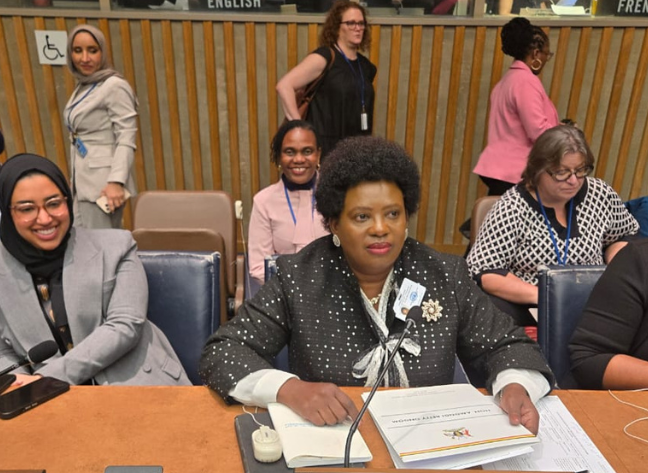

New York, USA | Uganda’s Minister for Gender, Labour and Social Development, Betty Amongi, has credited the political will of President Yoweri Kaguta Museveni for the significant progress the country has made in advancing women’s empowerment and leadership.
Speaking during the United Nations Commission on the Status of Women meeting at the United Nations headquarters in New York City on March 10, 2026, Amongi said Uganda has witnessed remarkable gains in women’s representation in decision-making positions due to deliberate government policies and affirmative action initiatives.
Amongi noted that women currently occupy about 45 percent of Cabinet positions in Uganda, including some of the country’s most powerful offices such as the Vice President, Prime Minister and Speaker of Parliament.
She added that women’s representation in Parliament stands at about 34 percent, while their participation in local government leadership has reached approximately 45 percent.
According to the minister, this increased representation has played a critical role in advancing policies that promote gender equality and women’s empowerment across the country.
However, Amongi acknowledged that despite these gains, women and girls in Uganda still face significant barriers in accessing justice.
She explained that patriarchal cultural norms, economic marginalization and gaps in the enforcement of laws continue to limit women’s ability to fully enjoy their rights.
Amongi also pointed out that customary laws in some communities still restrict women’s inheritance rights, leaving many widows vulnerable and without financial security.
She further noted that limited economic opportunities often push women into low-wage or informal employment, making it harder for them to access legal services and justice systems.
Despite these challenges, the minister said Uganda has enacted several legal frameworks aimed at protecting women and promoting gender equality.
These include the Domestic Violence Act (Uganda), the Prohibition of Female Genital Mutilation Act (Uganda), the Succession Act (Uganda) and the Prevention of Trafficking in Persons Act (Uganda).
She added that the government has also strengthened institutional mechanisms to support survivors of violence.
Amongi highlighted that the Uganda Police Force has established Gender and Children Desks to provide safe spaces where women can report cases of violence and seek assistance.
In addition, she said the Justice, Law and Order Sector (Uganda) has introduced gender-sensitive justice frameworks, specialized Gender-Based Violence courts, and expanded legal aid services.
The minister also pointed to the establishment of the Gender, Children and Sexual Offences Department at the Director of Public Prosecutions (Uganda) as part of the country’s commitment to strengthening justice for women and children.
She noted that the creation of Family and Children Courts has further improved the justice system by introducing procedures that are more sensitive to the needs of survivors.
Amongi said Uganda will continue engaging cultural and traditional leaders to challenge harmful customs while strengthening legal and institutional frameworks aimed at ensuring women and girls can fully access justice and participate in national development.