
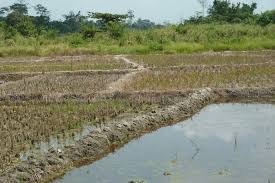

Alebtong, Uganda | As pressure mounts to protect Uganda’s fragile ecosystems, local leaders in Alebtong District are stepping in to manage wetland encroachment in the absence of strong enforcement mechanisms.
Their efforts underscore the growing role of grassroots governance in climate resilience as wetlands continue to be cleared for agriculture across the region.
Despite a 2021 presidential directive banning cultivation in wetlands, much of Alebtong’s wetland areas have been converted into farmland, with rice as the dominant crop.
Deputy Resident District Commissioner Mathias Lutwama acknowledged that although the directive grants legal authority to evict encroachers, implementation remains constrained by the socio-economic dependence of many residents on wetland resources—some of whom have cultivated these areas for over 20 years.
He stated that rather than relying on forced evictions, the district administration had opted for a mediation strategy.
This approach includes public education on environmental risks, boundary demarcation, and promotion of sustainable alternatives such as aquaculture.
However, the RDC’s office has come under fire, during a recent anti-corruption sensitization outreach by the Inspectorate of Government, members of the public accused the office of lax enforcement and failure to uphold the presidential directive.
In response, Lutwama defended the district’s strategy as inclusive and long-term, arguing that it focused on solving the root causes of wetland degradation.
In the face of these governance gaps, sub-county leaders have launched their own conservation initiatives.
In Awei Sub-county, LCIII Chairperson Sam Oyena Obonyo reported the formation of Wetland Management Committees at village and parish levels.
He said the committees were already producing positive results through community-led education and behavioural change campaigns.
In neighbouring Apala Sub-county, LCIII Chairperson George Sunday Opio also confirmed the establishment of local structures to curb wetland use.
However, he warned that their efforts were being diluted by neighboring areas where no similar initiatives exist. He stressed the need for coordinated regional enforcement to prevent conservation setbacks.
Further progress was reported in Ojul Parish, Apala Sub-county, where Committee Chairperson Okwir Fazil said the creation of 30-metre buffer zones—achieved through joint sensitization efforts with LCII officials—marked a key milestone in reducing encroachment.
These grassroots initiatives reflect growing frustration with inconsistent enforcement at the district level and highlight the increasing burden placed on local governments to fill the gap in environmental governance.
The community-led wetland protection efforts also contribute to Uganda’s broader climate goals and align with international calls for locally-driven solutions to ecological degradation.
President Yoweri Kaguta Museveni’s directive on wetland protection signaled a national shift in environmental policy, but its success now depends heavily on how local and regional leaders translate policy into practice.
With climate threats intensifying and pressure on land increasing, Alebtong’s experience demonstrates that when national directives falter, community-led action can keep the frontlines of conservation alive.
VOL FM