
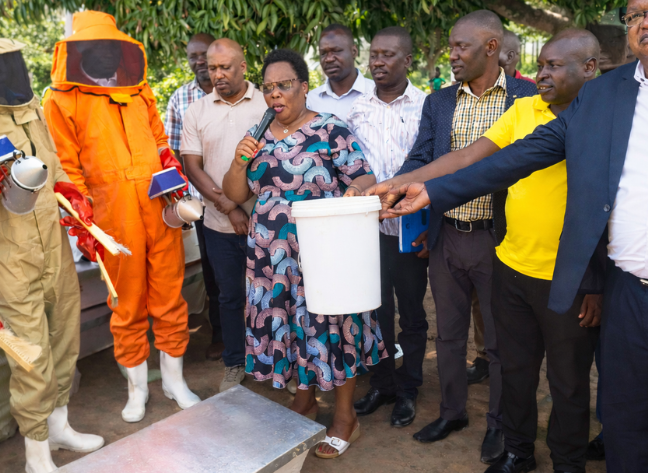

Dokolo, Uganda | Officials in Dokolo District have launched the distribution of agricultural inputs to farmers under the Uganda Climate Smart Agricultural Transformation Project (UCSATP), a government initiative aimed at improving agricultural productivity, household incomes, and resilience to climate change.
The launch, held on Friday in Dokolo Sub-county, saw two farmer groups — Mar En Gen Group in Abenyo Parish and Akut Badi En Papi Group in Alenga Parish — receive 400 modern beehives and related equipment to boost honey production.
The Uganda Climate Smart Agricultural Transformation Project is a six-year programme funded by the Ministry of Agriculture, Animal Industry and Fisheries (MAAIF) with support from the World Bank at a cost of Shs1.2 trillion.
Speaking during the launch, Dr. Patrick Opondo, the District Veterinary Officer and Focal Point Person for UCSATP in Dokolo, urged beneficiaries to utilize the equipment productively to transform their livelihoods.
“We want to see members using this equipment to improve their incomes, educate their children, and develop their communities,” Dr. Opondo said.
He noted that the two beneficiary groups are the first in Dokolo District, the Lango Sub-region, and Uganda at large to benefit from the project implementation phase.
Dr. Opondo further revealed that 232 farmer groups across Dokolo District are expected to benefit from the programme. These include 45 groups for beekeeping, 10 for black soldier fly farming, 120 for soya, mangoes and citrus production, 30 for beef farming, seven for fisheries, and 15 for aquaculture.
According to district production statistics, Dokolo produces about 45,258 kilograms of honey annually, with Dokolo Sub-county contributing 8,894 kilograms, representing nearly 20 percent of the district’s total production.
The District Production Officer, Dr. Richard Enyang, said the government will finance 80 percent of project costs while organized farmer groups contribute the remaining 20 percent.
“This arrangement is intended to ensure ownership and sustainability of the project among beneficiaries,” Dr. Enyang said, while commending the groups for their patience during the implementation process.
He estimated that honey production in Dokolo District generates more than Shs900 million annually, while Dokolo Sub-county alone contributes approximately Shs177 million.
Representing the Chief Administrative Officer, Denis Orit cautioned beneficiaries against theft of the beehives and urged the communities to safeguard the equipment.
He particularly warned against idle youth who may target the project inputs, calling on members to embrace and protect the initiative for long-term benefits.
Dokolo Deputy Resident District Commissioner (RDC), Ismael Masaba, emphasized the need for inclusiveness in the groups, encouraging the participation of youth and women.
Meanwhile, Dokolo RDC Babra Akech urged beneficiaries to take the project seriously, saying it is intended to combat household poverty and improve livelihoods.
“This project should not be treated casually like some other government programmes. We want to see real transformation and development among the beneficiary groups,” Akech said.
The UCSATP seeks to integrate climate-smart technologies into agriculture through improved infrastructure, stronger agricultural value chains, and enhanced community resilience to climate shocks.
Nationally, the project is expected to directly benefit 760,000 households and indirectly support an additional 1.9 million households across Uganda.