
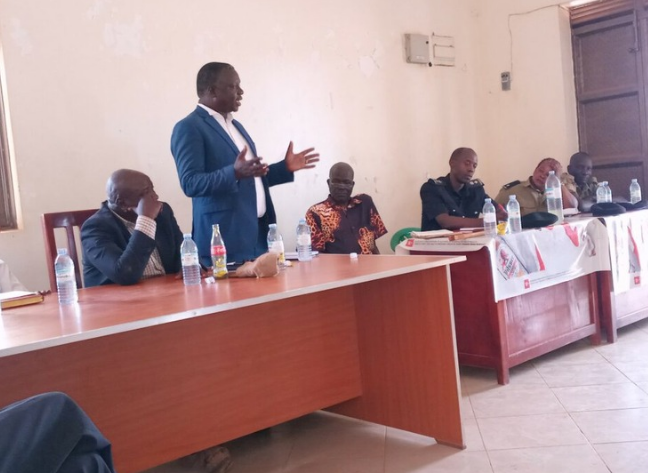

Oyam, Uganda – A growing rift between traditional clan leaders and the police in Oyam District took center stage on Wednesday March 19, 2025 during a high-stakes meeting at Oyam Guest House Annex, where 35 Lango cultural leaders voiced frustrations over what they see as police interference in matters historically governed by clan authority.
The discussions exposed deep-seated concerns over the erosion of cultural justice systems, alleged police misconduct, and the lack of a clear framework for cooperation between law enforcement and local leadership.
For centuries, clan leaders have played a pivotal role in resolving disputes, maintaining order, and preserving societal values within their communities.
However, many now feel their authority is being undermined by police officers who bypass them in conflict resolution.
Francis Odongo Alii, the Chairperson of all clan leaders in Oyam, sharply criticized the police for arresting individual clan Chiefs (Owitong) in cases that traditionally fall under clan jurisdiction, particularly incest cases.
He argued that handling incest through cultural channels prevents curses and reduces the spread of sexually transmitted infections within families.
Terence Omonya, the leader of the Pukica clan, accused the police of overstepping their mandate by taking over cases such as land disputes and domestic violence, which clan leaders have traditionally settled through mediation.
The issue of police corruption also dominated the discussions, with allegations that officers extort money from suspects seeking release on police bond.
Tile Robert Opuna, the Clan Chief of Atek Keno, confronted the Oyam District Police Commander (DPC), Job Mutegeki, demanding clarification on whether police bonds are genuinely free.
He cited an incident where a suspect was released but was rearrested two days later and asked to pay UGX 150,000 for bail.
“If police bonds are free as the law states, why do our people have to pay? We need answers, and we need accountability,” Tile Robert demanded.
Land disputes have long been a flashpoint for conflict in Oyam, and cultural leaders argue that the government’s failure to establish adequate police posts in rural farming areas has worsened the problem.
Jurubabel Opio Okori, a clan leader and Minister for Lands under Lango Cultural Institution, pointed out that in many areas, police officers depend on local farmers for survival since they are stationed in places where there are no designated police posts.
“The police are struggling just like the people. They have no proper posts, no resources, so they rely on residents for food. This dependency affects how they enforce the law,” Opio Okori noted.
Amid the tensions, some clan leaders acknowledged the efforts of individual officers who have worked closely with the community.
Sam Paul Ogwang Alunyu, the clan leader of Mwa Tiratok, commended Sgt. Odongo David Owino, the Community Liaison Officer for Oyam, for significantly reducing crime in Obanga Angeo, a once-notorious crime hub.
“Because of his commitment, we have seen a drastic improvement. This is the kind of policing we need—officers who understand our people and work with us instead of against us,” Alunyu stated.
He further announced that he would nominate Sgt. Owino for a medal from Lango Cultural Institution in recognition of his outstanding service to the community.
In response to the grievances raised, DPC SP Job Mutegeki assured the clan leaders that the police were willing to improve their working relationship with cultural institutions.
However, he issued a strong warning against the production of opium, which he identified as a major security threat in Oyam.
He particularly named Mitacoo, Otwal, Loro, and Abok as areas where illegal activities are thriving, and he vowed to take tough action if necessary.
While clan leaders seek greater recognition and autonomy in handling disputes, the police argue that some cases require formal legal intervention to ensure justice.
Moving forward, both sides agreed on the need for structured dialogue, with clan leaders pledging to educate their communities on legal matters while the police promised to consult cultural leaders in certain cases before making arrests.
One thought on “Oyam Clan Leaders Demand Justice Reform, Accuse Police of Ignoring Cultural Authority”
Comments are closed.